





2026 Chevy Trax Reliability Guide
An 84-out-of-100 quality and reliability score from J.D. Power, zero safety recalls on the 2026 model year, and a 5-year/60,000-mile powertrain warranty — here is how the 2026 Trax actually holds up, from Lash Chevrolet in Johnstown, OH.
Is the 2026 Chevy Trax reliable?
Yes. The 2026 Chevrolet Trax earns an 84-out-of-100 Quality & Reliability score from J.D. Power — a "Great" rating — and Consumer Reports predicts it will be more reliable than the average new vehicle based on 2024 and 2025 owner data. No NHTSA safety recalls have been issued against the 2026 model year as of September 2026, and Chevrolet backs every Trax with 3-year/36,000-mile bumper-to-bumper and 5-year/60,000-mile powertrain coverage. Chevrolet as a brand also placed third among mass-market nameplates in the J.D. Power 2026 U.S. Vehicle Dependability Study at 178 problems per 100 vehicles, comfortably better than the 204 industry average. See full 2026 Chevy Trax model details and current availability at Lash Chevrolet in Johnstown, OH.
The question comes up on almost every Trax test drive, usually about ninety seconds in: it only has three cylinders — is that going to hold up? It is a fair thing to ask about an engine the size of a two-liter soda bottle propelling a five-passenger SUV, and it deserves a real answer rather than a shrug.
Here is the short version. Chevrolet redesigned the Trax from the ground up for 2024, so the 2026 model is the third year of a mature design rather than a first-year experiment — and third-party scoring has landed on the favorable side of average. The 2026 Chevy Trax features and trim lineup carries over the same 1.2L turbocharged three-cylinder and six-speed automatic that have been in customer hands since early 2023, which is why the reliability picture is clearer than the model year alone suggests.
Reliability also is not a single number you can look up. It is a blend of how often something breaks, how expensive it is when it does, how long the factory stands behind it, and how faithfully the owner follows the maintenance schedule. That last variable is the one you actually control, and it is where our Chevrolet Certified Service department sees the sharpest difference between a Trax at 120,000 miles that still feels tight and one that does not.
This guide walks through the published ratings, the warranty terms, the maintenance intervals that matter most on a small turbocharged engine, and the issues current-generation owners have actually reported. At Lash Chevrolet in Johnstown, OH — serving Columbus, Westerville, Gahanna, New Albany, Newark, and Sunbury — we would rather you buy with the full picture than find it out at 40,000 miles.
Key Takeaways
- J.D. Power scores the 2026 Trax 84 out of 100 for Quality & Reliability and 83 out of 100 overall
- Consumer Reports expects the 2026 Trax to be more reliable than the average new car, based on 2024 and 2025 owner data
- Chevrolet finished third among mass-market brands in the J.D. Power 2026 U.S. Vehicle Dependability Study at 178 PP100, against a 204 industry average
- No NHTSA safety recalls have been issued for the 2026 Chevy Trax as of September 2026
- Coverage runs 3 years/36,000 miles bumper-to-bumper, 5 years/60,000 miles powertrain, 6 years/100,000 miles rust-through, plus one complimentary maintenance visit
- The 1.2L turbo three-cylinder requires dexos1 Gen 3 0W-20 full synthetic oil — roughly 4.2 quarts with the filter — and that specification is not a suggestion
- Early 2024 builds drew instrument-cluster and transmission-shudder complaints, both addressed through a safety recall and a GM service bulletin
2026 Chevy Trax Reliability Ratings and Scores
Three independent measurements matter most when you are sizing up a new vehicle, and the 2026 Trax clears all three without needing an asterisk. J.D. Power assigns it an 84-out-of-100 Quality & Reliability score, which sits in the "Great" band and reflects reported defects and design flaws rather than opinion.
Consumer Reports takes a different route to a similar conclusion. Rather than testing a 2026 unit, it projects forward from survey responses on the 2024 and 2025 Trax and expects the 2026 model to be more reliable than the average new car. That is a meaningful statement for a vehicle in this price class, where cost-cutting usually shows up as warranty claims.
The third data point is broader but arguably the most useful, because it is built on three-year-old vehicles rather than new ones. In the J.D. Power 2026 U.S. Vehicle Dependability Study, Chevrolet ranked third among all mass-market brands at 178 problems per 100 vehicles, with the industry average sitting at 204 PP100. Brand-level dependability does not guarantee any single model, but it tells you how the parts, software, and service network are performing across the board.
What none of these scores capture is a long field history, because there simply is not one yet for a nameplate redesigned in 2024. That is the honest caveat: the current Trax has roughly three model years of data behind it, not fifteen. The trend across those three years has been steady rather than alarming, which is the pattern you want to see.
| Rating Source | What It Measures | 2026 Trax Result | Verdict |
|---|---|---|---|
| J.D. Power Quality & Reliability | Reported defects and design flaws | 84 out of 100 | Great |
| Consumer Reports Predicted Reliability | Projected trouble spots from 2024–2025 owner surveys | Better than the average new car | Above average |
| J.D. Power 2026 Vehicle Dependability Study (Chevrolet brand) | Problems per 100 three-year-old vehicles | 178 PP100 vs. 204 industry average | 3rd among mass-market brands |
Read together, the message is consistent: the Trax is scoring at or above the segment norm, and Chevrolet's broader dependability picture is trending the right direction.
The 1.2L Turbo Three-Cylinder: Built for Durability?
The engine is where skepticism concentrates, so it is worth understanding what it actually is. The 2026 Trax uses a 1.2L turbocharged three-cylinder producing 137 horsepower and 162 lb.-ft. of torque, paired with a conventional six-speed automatic driving the front wheels. Three cylinders is unusual in North America, but this architecture has been running in Chevrolet and Buick crossovers for several years and in GM's global lineup for longer.
The transmission choice deserves more credit than it gets. Chevrolet did not fit a continuously variable transmission here — the Trax uses a torque-converter automatic with six gears, a design with decades of service history and none of the belt-and-pulley wear concerns that make some shoppers nervous. Fewer speeds means less shift complexity, and a torque converter absorbs driveline shock that a clutch pack would otherwise take.
Small turbocharged engines do carry one genuine vulnerability: they run hot and they work hard, and they are unforgiving about oil. The 1.2L specifies dexos1 Gen 3 0W-20 full synthetic — approximately 4.2 quarts with a new filter — and that specification exists specifically to guard against low-speed pre-ignition, a phenomenon that can damage pistons in direct-injected turbo engines fed the wrong oil. Use the correct fluid on schedule and this engine behaves; skip it and you are gambling with the most expensive component in the vehicle.
| Component | 2026 Trax Specification | Recommended Service | Durability Notes |
|---|---|---|---|
| Engine | 1.2L turbocharged 3-cylinder, 137 hp / 162 lb.-ft. | dexos1 Gen 3 0W-20 full synthetic, about 4.2 qt. | Correct oil is the single biggest lever on turbo longevity |
| Transmission | 6-speed automatic, front-wheel drive | Fluid drain and fill in the 45,000-mile range | Torque-converter design — no CVT belt to wear |
| Cooling System | Pressurized coolant circuit handling turbo heat load | Inspect at every service; exchange per owner's manual | Heat management is what keeps a small turbo alive |
| Air Intake | Turbocharged induction with engine air filter | Filter replacement per the maintenance schedule | A restricted filter makes the turbo work harder than designed |
| Chassis | 2,983 lbs. curb weight, 106-inch wheelbase | Tire rotation every 7,500 miles | Light curb weight reduces brake, tire, and suspension load |
The short answer on the three-cylinder: it is a modern, proven design that rewards discipline about oil and punishes neglect faster than a big naturally aspirated engine would.
How Vehicle Reliability Is Actually Measured
Reliability scores get quoted constantly and understood rarely, which leads to shoppers comparing numbers that measure completely different things. Knowing what sits behind each figure makes the 2026 Trax picture much easier to read.
J.D. Power's headline dependability metric is PP100 — problems per 100 vehicles — collected from owners of three-year-old vehicles. Lower is better, and a squeaking trim panel counts alongside a failed sensor, which is why even excellent brands post scores in the triple digits. When Chevrolet records 178 PP100 against a 204 average, it means Chevy owners reported roughly 26 fewer problems per hundred vehicles than the typical brand.
Consumer Reports works from a different foundation: annual member surveys covering 17 trouble areas, from the engine and transmission down to in-car electronics and paint. For a model year that has not been on the road long enough to survey, it publishes a prediction built from the two prior years. That is exactly the situation with the 2026 Trax, and it is why the wording is "expected to be more reliable than average" rather than a hard score.
Recalls and technical service bulletins are a third category entirely, and they are frequently confused. A recall is a safety-related defect that the manufacturer must repair free of charge, tracked by NHTSA campaign number and searchable by VIN. A service bulletin is internal guidance to technicians for diagnosing a known pattern — it is not a defect notice, and a model having bulletins is normal rather than damning.
The last thing worth knowing is that initial quality and long-term dependability are separate studies measuring separate moments. A vehicle can post a middling initial quality score because owners dislike the infotainment menus and still prove mechanically durable at 100,000 miles. When you are shopping for something to keep, dependability data on older vehicles is the more honest signal.
2026 Chevy Trax Warranty Coverage
A warranty is a manufacturer putting money behind its own reliability estimate, so the terms tell you something the ratings do not. The 2026 Trax carries Chevrolet's standard new-vehicle coverage: 3 years or 36,000 miles bumper-to-bumper and 5 years or 60,000 miles on the powertrain, whichever comes first.
Powertrain coverage is the one that matters for the questions people actually ask about a three-cylinder. It covers the engine, transmission, and drive components — the assemblies that would turn a repair into a real financial event — for a full five years. Roadside assistance runs alongside it at 5 years/60,000 miles, and rust-through protection extends to 6 years/100,000 miles.
Chevrolet also includes one complimentary maintenance visit during the first year, covering an oil and filter change, a tire rotation, and a multi-point inspection. It is a modest benefit on paper, but it gets a new owner into the service lane once, which is often what establishes the habit that keeps the vehicle healthy.
Worth knowing for the years after the factory coverage ends: replacement parts installed by a GM dealership carry their own warranty, and some chassis and wear components are covered for as long as you own the vehicle. Our Chevrolet parts warranty details lay out which components fall under the 24-month, 12-month, and limited lifetime tiers.
| Coverage Type | Term | What It Covers |
|---|---|---|
| Bumper-to-Bumper Limited Warranty | 3 years / 36,000 miles | Most vehicle components against defects in materials or workmanship |
| Powertrain Limited Warranty | 5 years / 60,000 miles | Engine, transmission, and drive system assemblies |
| Roadside Assistance | 5 years / 60,000 miles | Towing, jump-starts, lockout and flat-tire assistance |
| Rust-Through Protection | 6 years / 100,000 miles | Body sheet metal panels perforated by corrosion |
Terms are whichever comes first and are subject to Chevrolet's published limitations — ask us to print the coverage summary for the specific VIN you are considering.
The Maintenance Schedule That Keeps a Trax Reliable
Every reliability statistic you read is an average of well-maintained vehicles and neglected ones. The 2026 Trax does not use fixed-mileage oil changes; it runs an Engine Oil Life System that monitors driving conditions and prompts you when the oil is actually spent, with an outer limit of at least once a year regardless of mileage.
Why Oil Discipline Matters More on a Turbo Three-Cylinder
A 1.2L turbo produces the output of a much larger engine, and it does that by running higher cylinder pressures and hotter turbine temperatures. That combination is what makes low-speed pre-ignition a real risk with the wrong oil — and why the dexos1 Gen 3 0W-20 full synthetic specification is written into the owner's manual rather than left to preference. Our Chevrolet Certified Service oil change uses the dexos-approved synthetic this engine requires, so the spec is never the variable.
The other high-leverage item on a front-wheel-drive vehicle is tire rotation. The front tires on a Trax handle steering, the majority of braking, and all of the power delivery, so they wear noticeably faster than the rears. Rotating every 7,500 miles evens that out and protects the alignment and suspension components downstream — and our new tire selection and price match makes the eventual replacement less painful than it needs to be.
| Service Item | Interval | Why It Matters |
|---|---|---|
| Engine oil and filter | When the Oil Life System prompts, at minimum once per year | Protects the turbocharger and guards against pre-ignition damage |
| Tire rotation | Every 7,500 miles | Evens front-drive wear and extends tire life |
| Multi-point inspection | Every service visit | Catches fluid leaks, brake wear, and hose issues while they are small |
| Engine air filter | Per the owner's manual schedule | A restricted filter forces the turbo to work harder for the same power |
| Transmission fluid | Drain and fill in the 45,000-mile range | Keeps the six-speed shifting cleanly and reduces converter stress |
| Cabin air filter | Per the owner's manual schedule | Protects blower motor airflow and cabin air quality |
Intervals vary with how you drive — short winter trips around Johnstown are harder on oil than highway miles to Columbus, and the Oil Life System accounts for that automatically.
Known Issues on the Current-Generation Trax
A reliability guide that only lists good news is not a reliability guide. The current Trax generation launched for 2024, and like most redesigns it collected a set of early complaints that are worth knowing about — partly for context on the 2026 model, and partly if you are shopping a pre-owned example.
The most significant was an intermittent instrument panel blackout on 2024 units, traced to software in the display module. Chevrolet issued a formal safety recall for it (NHTSA campaign 23V744000), and the remedy was a software reflash performed at the dealership at no charge. It was a genuine defect, it was identified quickly, and it was fixed under a recall rather than left to owners.
A second cluster of 2024 complaints involved a transmission shudder or a humming, growling noise at roughly 28 to 53 mph. GM's service guidance points technicians to two possible causes — an active noise cancellation software issue resolved with a radio module update, or a torque converter that needs replacement — with the software check first. Electrical and infotainment items made up the largest complaint category overall on 2024 and 2025 builds, which is typical of a modern vehicle where most features route through software.
The relevant point for 2026: no NHTSA safety recalls have been issued against this model year as of September 2026, and the early software issues have had two model years of updates behind them. If any concern does surface on your vehicle, the fix is a diagnostic appointment, not a forum thread — you can request a service appointment in Johnstown, OH and we will run the VIN for open recalls and bulletins at the same time.
| Reported Issue | Model Years Affected | Status and Remedy |
|---|---|---|
| Intermittent instrument panel blackout | 2024 | Safety recall 23V744000 — free software reflash of the display module |
| Transmission shudder or driveline noise at 28–53 mph | 2024 | Addressed by GM service bulletin — radio software update, torque converter replacement if it persists |
| Electrical and infotainment complaints | 2024–2025 | Largest complaint category; handled through software updates under warranty |
| Engine-related owner complaints | 2024–2025 | Second-largest category; covered by the 5-year/60,000-mile powertrain warranty |
| Open safety recalls on the 2026 model year | 2026 | None issued as of September 2026 — verify by VIN before purchase |
Any recall lookup should be done by VIN rather than by model year, because campaigns are issued against specific build ranges and we can check yours in a minute.
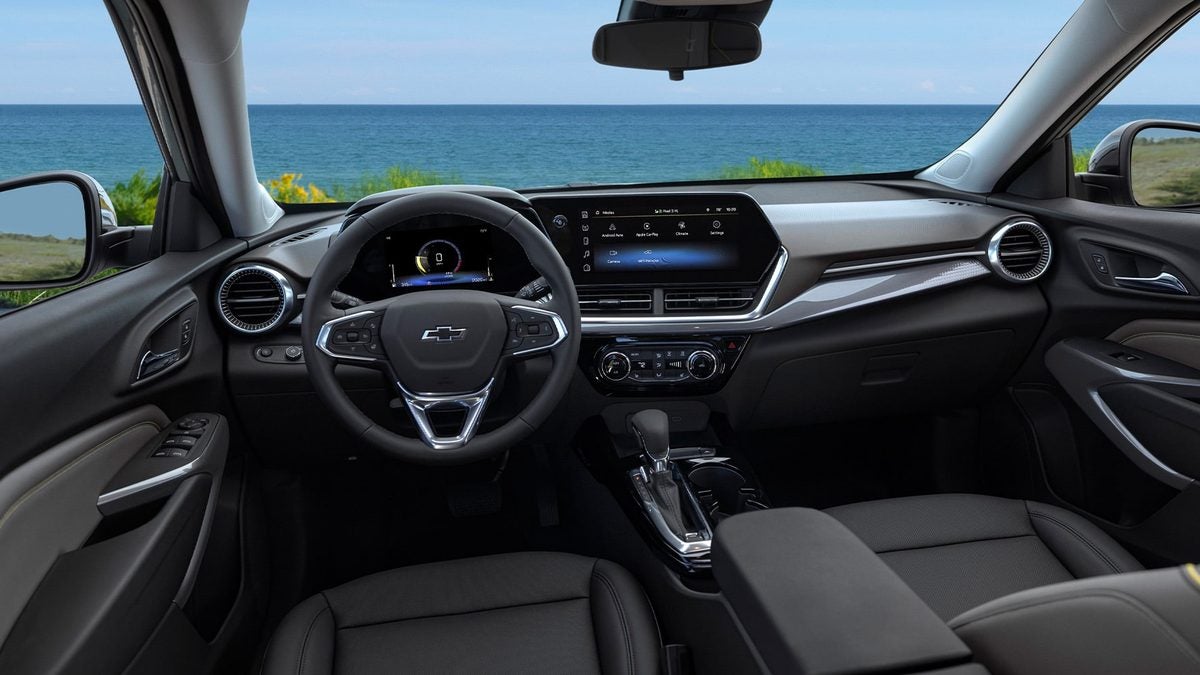
The 2026 Trax instrument cluster is where the Engine Oil Life System posts its change-oil prompt — the most important maintenance signal on a turbocharged engine.
Cost of Ownership: Reliability You Can Budget
Reliability shows up in your bank account long before it shows up in a repair invoice, and the Trax is built around that idea. It starts at $21,700 for the LS, which makes it one of the least expensive new SUVs on any lot in central Ohio, and it uses regular unleaded rather than premium.
Fuel economy comes in at an EPA-estimated 28 mpg city, 31 mpg highway, and 29 mpg combined across the lineup, with a roughly 13-gallon tank producing something close to 380 miles of combined range. Those are numbers that hold up on a Columbus commute, and they mean fewer fill-ups than almost anything else with an SUV badge on the tailgate.
Routine service costs stay modest because the parts count is modest: about 4.2 quarts of oil instead of six or eight, front-wheel drive with no transfer case or rear differential to service, and a conventional automatic rather than a CVT. There are no timing-belt intervals to budget for and no all-wheel-drive hardware to maintain, since the 2026 Trax is front-drive only.
Resale is the other half of the equation, and J.D. Power's three-year depreciation forecast puts the Trax at 82 out of 100 — another "Great" rating. If a lower entry price is the priority, we also keep a rotating selection of used SUVs for sale in Johnstown, OH that includes earlier Trax model years.
| Ownership Factor | 2026 Chevy Trax |
|---|---|
| Starting MSRP (LS) | $21,700 |
| EPA-estimated fuel economy | 28 city / 31 highway / 29 combined mpg |
| Required fuel | Regular unleaded |
| Engine oil | dexos1 Gen 3 0W-20 full synthetic, about 4.2 quarts |
| J.D. Power resale forecast | 82 out of 100 (Great) |
Pricing excludes destination freight, taxes, and fees and is subject to change — ask us for an out-the-door figure on a specific vehicle.
Reliability by Trim: Which 2026 Trax Ages Best
Every 2026 Trax shares the same engine, the same transmission, and the same front-wheel-drive layout, so mechanical durability does not change as you move up the range. What changes is the number of systems that can eventually need attention — screens, motors, sensors, and heated surfaces are all features you can enjoy and also, eventually, repair.
The LS ($21,700) is the simplest configuration in the lineup: 17-inch alloy wheels, an 8-inch touchscreen, wireless Apple CarPlay and Android Auto, and the standard Chevy Safety Assist suite. Fewer powered features means fewer failure points over a long ownership horizon, which is why it appeals to buyers planning to keep the vehicle past the warranty.
The 1RS ($23,200) adds sport styling and machined 17-inch wheels without adding meaningful complexity, while the LT ($23,200) is the practical pick — it brings the 11-inch HD touchscreen, an 8-inch driver display, and a six-speaker audio system, with heated seats and wireless charging available.
The 2RS ($25,400) and ACTIV ($25,400) sit at the top with 18-inch wheels, blind-spot monitoring, rear cross-traffic alert, adaptive cruise control, and a power driver's seat. Both are excellent daily drivers; just recognize that larger wheels mean shorter-sidewall tires that cost more to replace and transmit more pothole impact into the suspension.
If the Trax feels close but you want all-wheel drive or a larger cabin, the step up is worth a look — our Chevy Equinox trim levels guide covers the next size class, and the Equinox took top honors in its segment in the J.D. Power 2026 dependability study.
| Trim | Starting MSRP | Wheels | Touchscreen | Long-Term Ownership Notes |
|---|---|---|---|---|
| LS | $21,700 | 17-inch alloy | 8-inch | Fewest powered systems — simplest to keep long-term |
| 1RS | $23,200 | 17-inch machined alloy | 8-inch | Styling upgrade with no added mechanical complexity |
| LT | $23,200 | 17-inch alloy | 11-inch HD | Best balance of features and smaller-wheel tire costs |
| 2RS | $25,400 | 18-inch machined alloy | 11-inch HD | More driver-assist hardware; pricier tire replacements |
| ACTIV | $25,400 | 18-inch alloy | 11-inch HD | Rugged styling, same powertrain; budget for 18-inch tires |
Starting prices exclude destination freight and are subject to change — feature availability varies by build, so confirm equipment on the specific Trax you are considering.
Conclusion
The 2026 Chevy Trax is a reliable small SUV by the measures that can be checked: 84 out of 100 for quality and reliability from J.D. Power, an above-average prediction from Consumer Reports, no open safety recalls on the model year, and a five-year powertrain warranty behind an engine that has been in customer hands since 2023.
The caveats are worth repeating honestly. This is a three-model-year-old design rather than a decade-proven one, the early 2024 builds needed a recall and a service bulletin, and a small turbocharged engine is genuinely less forgiving about oil than a big four-cylinder. Follow the schedule with the specified dexos1 Gen 3 synthetic and none of that should ever become your problem.
Lash Chevrolet in Johnstown stocks the Trax across the trim range for shoppers near Columbus, Westerville, Gahanna, New Albany, Galena, and Sunbury, and our Certified Service team maintains them long after the sale. We are grateful to be counted among the best car dealerships in Ohio for family SUVs — come drive one and we will pull the service history and warranty details with you.
Want to See the 2026 Trax Reliability Story in Person?
Visit Lash Chevrolet in Johnstown, OH to drive the 2026 Trax, review warranty coverage line by line, and check open recalls by VIN on any vehicle in stock. Schedule your test drive today.
Frequently Asked Questions
Is the 2026 Chevy Trax reliable?
Yes. The 2026 Chevrolet Trax earns an 84-out-of-100 Quality & Reliability score from J.D. Power, rated "Great," and Consumer Reports expects it to be more reliable than the average new car based on 2024 and 2025 owner data. Chevrolet also finished third among mass-market brands in the J.D. Power 2026 U.S. Vehicle Dependability Study at 178 problems per 100 vehicles, against a 204 industry average.
Is the 1.2L three-cylinder engine in the Trax durable?
The 1.2L turbocharged three-cylinder makes 137 horsepower and 162 lb.-ft. of torque and has been in production in GM crossovers since the current Trax launched for 2024. It is a modern direct-injected turbo design, which means it is sensitive to oil quality: it requires dexos1 Gen 3 0W-20 full synthetic, roughly 4.2 quarts with the filter, specifically to prevent low-speed pre-ignition. Kept on that schedule, it is covered by Chevrolet's 5-year/60,000-mile powertrain warranty.
Does the 2026 Chevy Trax have any recalls?
No NHTSA safety recalls have been issued for the 2026 Chevrolet Trax as of September 2026. The 2024 model year did receive one recall (campaign 23V744000) for an intermittent instrument panel blackout, remedied with a free software update. Because recalls are issued against specific build ranges, always confirm by VIN rather than by model year — our service team can run that check for you.
What warranty comes with the 2026 Chevy Trax?
Coverage includes a 3-year/36,000-mile bumper-to-bumper limited warranty, a 5-year/60,000-mile powertrain limited warranty, 5 years/60,000 miles of roadside assistance, and 6 years/100,000 miles of rust-through protection, whichever comes first. Chevrolet also includes one complimentary maintenance visit in the first year covering an oil and filter change, a tire rotation, and a multi-point inspection.
How long will a Chevy Trax last?
Chevrolet does not publish a lifespan figure, and the current-generation Trax has only been on the road since 2024, so there is no long-term odometer record for it yet. What the data does support is that maintenance is the deciding variable on a small turbocharged engine: following the Engine Oil Life System prompts with dexos1 Gen 3 synthetic, rotating tires every 7,500 miles, and servicing the transmission fluid around 45,000 miles are what separate a Trax that ages well from one that does not.
What problems do 2024 and 2025 Chevy Trax owners report?
The two best-documented issues are an intermittent instrument panel blackout on 2024 units, corrected under safety recall 23V744000, and a transmission shudder or humming noise around 28 to 53 mph on 2024 builds, which GM service guidance addresses with a radio software update first and a torque converter replacement if the noise persists. Electrical and infotainment items make up the largest owner complaint category overall, and most are resolved with software updates under warranty.
What oil does the 2026 Chevy Trax require?
The 1.2L turbo engine requires dexos1 Gen 3 0W-20 full synthetic oil, with a capacity of approximately 4.2 quarts including a new filter. The dexos1 Gen 3 specification is what provides protection against low-speed pre-ignition in small direct-injected turbo engines, so substituting a non-approved oil is not a savings — it is a risk to the pistons. The Trax uses an Engine Oil Life System rather than a fixed mileage interval, prompting you when a change is actually due and at least once per year.
Which 2026 Trax trim is best for long-term ownership?
All five trims — LS, 1RS, LT, 2RS, and ACTIV — use the identical engine, transmission, and front-wheel-drive layout, so mechanical durability is the same across the range. The LS at $21,700 has the fewest powered systems and rides on 17-inch wheels with cheaper tire replacements, which appeals to buyers keeping the vehicle past warranty. The LT at $23,200 is the balanced choice, adding the 11-inch touchscreen while keeping 17-inch wheels.
Where can I get a Chevy Trax serviced near Columbus, OH?
Lash Chevrolet's Certified Service department in Johnstown, OH serves Trax owners across Columbus, Westerville, Gahanna, New Albany, Newark, Galena, and Sunbury. Our technicians are trained on the 1.2L turbo powertrain, stock the dexos1 Gen 3 synthetic oil it requires, and can check any VIN for open recalls and service bulletins during the visit. Service hours run Monday through Thursday 7:00 AM to 6:00 PM and Friday 7:00 AM to 5:00 PM.