





2026 Bad Credit Car Financing Guide
Current auto loan rates by credit score, what lenders weigh beyond the number, the paperwork to bring and the moves that shrink your payment — from the finance team at Lash Chevrolet in Johnstown, OH.
Can you get car financing with bad credit in 2026?
Yes. Lenders approve auto loans in every credit tier, but a lower score raises the price of borrowing. Experian's Q2 2026 data puts the average used-car APR at 19.10% for subprime borrowers (VantageScore 501–600) and 21.62% for deep subprime (300–500), compared with 8.81% for prime borrowers. Steady income, a down payment of 10% or more, a realistic vehicle price and a shorter term all improve both your approval odds and your rate. At the subprime average, a $20,000 used-car loan over 60 months costs about $520 a month. For local help, Lash Chevrolet offers second chance auto financing in Johnstown, OH through local credit unions and a network of national lenders.
Most people who ask about financing with bad credit are really asking two things at once: will anyone approve me, and will the payment be something I can live with? The first answer is usually yes. The second depends on decisions you make before you ever sign, and that is where this bad credit car financing guide spends most of its time.
Bad credit rarely comes from carelessness. A layoff, a medical bill, a divorce or a co-signed loan that went sideways can pull a score into the 500s within a year. Lenders know that, which is why the auto market has an entire tier of financing built for people who are rebuilding. We hear the same worries every week — bankruptcy, a past repossession, no credit history at all — and we answer the most common ones in our bad credit auto financing FAQ.
What changes with a lower score is the cost. In 2026, the gap between the average prime and subprime used-car rate is more than ten percentage points, and over a typical loan that difference adds up to thousands of dollars in interest. The encouraging part is that several of the biggest levers — your down payment, the loan term, the vehicle's price and whether you add a co-borrower — are entirely in your hands.
Below you will find current average rates by credit tier, what lenders check besides your score, the documents to bring, the contract terms worth slowing down for and how to set yourself up to refinance later. At Lash Chevrolet in Johnstown, OH, serving Columbus, Westerville, Gahanna, New Albany, Galena, Sunbury and Pataskala, we would much rather you walk in prepared than walk out surprised.
Key Takeaways
- Bad credit car financing is widely available in 2026, but subprime used-car loans averaged 19.10% APR in Experian's Q2 2026 data, against 8.81% for prime borrowers
- Experian sorts auto borrowers into five VantageScore 4.0 tiers: super prime 781–850, prime 661–780, near prime 601–660, subprime 501–600 and deep subprime 300–500
- Many subprime lenders look for roughly $1,500 to $2,000 in gross monthly income and a car-plus-insurance payment under 15% to 20% of that income
- Multiple auto loan inquiries made within 14 to 45 days generally count as a single inquiry, according to the Consumer Financial Protection Bureau
- On a $22,000 used vehicle at 19.10% APR for 60 months, putting 10% down lowers the payment by about $57 a month and saves roughly $1,230 in interest
- Stretching a $20,000 subprime loan from 60 to 84 months lowers the payment but adds about $5,200 in interest
- About 12 months of on-time payments can open the door to refinancing at a lower rate
Average Car Loan Interest Rates by Credit Score in 2026
Your credit score sets the starting point for your APR, and the spread between tiers is wider than most shoppers expect. Experian's State of the Automotive Finance Market report for the second quarter of 2026, the latest quarter published as of this writing, breaks average rates into five tiers using VantageScore 4.0.
Two patterns stand out. Used-vehicle loans carry higher rates than new-vehicle loans in every tier, by roughly two to five and a half percentage points. And on the used side, each step down from prime to near prime to subprime adds about five points of APR, which is why moving up even one tier before you buy can be worth real money.
Averages are not quotes. Two borrowers with the same score can receive different offers because lenders also price the amount borrowed against the vehicle's value, the term, the vehicle's age and mileage, and how stable the applicant's income looks. Credit unions sometimes beat the averages for their members, while manufacturer promotional rates on new vehicles are generally reserved for well-qualified buyers.
Lenders also do not all use the same score. Experian's tiers are built on VantageScore 4.0, but many auto lenders pull a FICO Auto Score, an industry-specific version that runs from 250 to 900. Depending on which model a lender uses, the tier you land in can shift.
| Credit Tier | Score Range (VantageScore 4.0) | Average New-Car APR | Average Used-Car APR |
|---|---|---|---|
| Super prime | 781–850 | 4.41% | 6.29% |
| Prime | 661–780 | 6.15% | 8.81% |
| Near prime | 601–660 | 9.71% | 13.93% |
| Subprime | 501–600 | 13.52% | 19.10% |
| Deep subprime | 300–500 | 16.11% | 21.62% |
Source: Experian State of the Automotive Finance Market, Q2 2026. Your actual rate depends on lender approval and your complete application.
What Lenders Check Besides Your Credit Score
A credit score tells a lender how you have handled debt in the past. The rest of the application tells them whether this particular loan is likely to be repaid. With bad credit, those other factors carry more weight, not less, and that works in your favor because most of them can be documented or improved quickly.
Income is the anchor. Many subprime lenders look for gross monthly income of roughly $1,500 to $2,000 before taxes, from full-time work or a guaranteed fixed source such as Social Security or a pension. They then run two ratios: payment-to-income, which compares the estimated car and insurance payment with your gross pay, and debt-to-income, which adds that new payment to everything else you owe each month.
Stability rounds out the picture. Time at your current job and address, a working phone number and verifiable references all show a lender that your income is likely to continue and that they can reach you. Cash down or trade-in equity lowers the amount financed, which reduces the lender's risk and often improves the rate you are offered.
| Factor | What Many Subprime Lenders Look For | How to Document It | Why It Matters |
|---|---|---|---|
| Gross monthly income | Roughly $1,500–$2,000 or more before taxes | Recent pay stubs, benefit award letters or bank statements | Sets the largest payment a lender will approve |
| Payment-to-income (PTI) | Car plus insurance payment under about 15%–20% of gross income | Calculated by the lender from your income and the deal structure | Keeps the payment affordable on paper and in daily life |
| Debt-to-income (DTI) | All monthly obligations, including the new payment, under about 45%–50% of gross income | Your credit report plus housing costs you list on the application | Shows there is room in the budget for one more bill |
| Job and residence stability | Steady employment and a consistent address history | Employer contact details, a lease or recent utility bills | Signals that your income is likely to continue |
| Down payment or trade equity | Cash down, positive trade-in equity or both | Bank statement, trade-in title or lender payoff letter | Lowers the amount financed and the lender's risk |
These ranges are common industry guidelines, not fixed rules. Every lender sets its own criteria, and a strong down payment can offset a weaker ratio.
How Bad Credit Auto Financing Works
There are three common routes to a car loan with bad credit: a direct loan from a bank or credit union, financing arranged by a franchised dealership, and in-house financing from a buy-here-pay-here lot. Each one works differently, and understanding the differences helps you compare offers on equal terms.
With a direct loan, you apply to the lender yourself and arrive at the dealership with a preapproval in hand. Credit unions can be flexible with members, though many set firmer score minimums. With dealer-arranged financing, the dealership submits one application to a network of lenders, including banks, credit unions, captive manufacturer lenders and specialty subprime lenders, and comes back with the offers that approve. The Federal Trade Commission's car financing guidance notes that a dealer-arranged APR usually includes compensation for handling the financing, so it pays to compare that offer with any preapproval you bring. Our Lash Chevrolet finance department is glad to make that side-by-side comparison with you.
Buy-here-pay-here dealers lend their own money, so approval can be easier, but rates tend to sit at the top of the market, vehicle choices are limited and some of these lenders do not report on-time payments to all three credit bureaus. If a lender does not report, your loan may do little to rebuild your score, so ask directly whether payments are reported to Equifax, Experian and TransUnion.
Rate shopping is safer than many people assume. According to the Consumer Financial Protection Bureau's guidance on auto loan shopping, multiple auto loan inquiries generally count as a single inquiry when they are made within 14 to 45 days of each other, depending on the scoring model. Keep your comparisons inside a two-week window and the effect on your score stays small.
Finally, check your credit reports before you shop. Equifax, Experian and TransUnion each provide free weekly reports through AnnualCreditReport.com, and correcting an error, such as a paid collection still listed as open or an account that is not yours, is one of the quickest ways to lift a score before you apply.
Documents to Bring for a Bad Credit Car Loan
Subprime approvals are often conditional: the lender says yes, provided you can verify what you put on the application. Bringing the paperwork with you shortens that step from days to minutes and keeps a good offer from expiring while you search for a pay stub.
The list below covers what most lenders request. Not every lender asks for every item, and self-employed buyers or those on a fixed income will usually substitute tax returns, 1099s, bank statements or benefit award letters for pay stubs.
If your credit history includes a bankruptcy, bring the discharge papers. If the case is still open, which is common during a Chapter 13 repayment plan, you will typically need written permission from your bankruptcy trustee before taking on a new loan, so request it early.
A co-borrower with stronger credit can help an application, but only if that person understands they are fully responsible for the debt. Their proof of income, address and identification will be needed as well.
| Document | Common Examples | Why Lenders Ask |
|---|---|---|
| Proof of income | Your most recent pay stubs, or tax returns and bank statements if self-employed | Verifies the income used to set your payment limit |
| Proof of residence | A recent utility bill, lease or mortgage statement in your name | Confirms your current address and how long you have lived there |
| Valid driver's license | A current state-issued license | Confirms your identity and that you can legally drive the vehicle |
| Personal references | Names and current phone numbers for several people who know you | Helps the lender verify your information and reach you |
| Proof of insurance | An insurance card or your agent's contact information | Lenders require full coverage on a financed vehicle |
| Down payment and trade-in paperwork | Bank verification for cash down, plus the trade-in title or payoff letter | Confirms the cash and equity going into the deal |
Requirements vary by lender. Call ahead and our team will tell you exactly what your application needs before you make the drive to Johnstown.
How to Improve Your Approval Odds Before You Apply
A few weeks of preparation can move you into a better rate tier or, at the very least, into a smaller loan. None of these steps requires perfect credit, only a plan and a little lead time.
Why a Down Payment Does More Work When Your Credit Is Bruised
When rates are high, every dollar you do not borrow saves more. On a $22,000 used vehicle financed for 60 months at the Q2 2026 subprime average of 19.10%, putting 10% down drops the payment from about $572 to about $515 a month and trims roughly $1,230 in interest, while 20% down brings the payment to about $458. Run your own numbers with our auto loan payment calculator before you shop, and set a monthly ceiling you will not cross.
Next, look hard at the term. Longer loans lower the monthly payment, but at subprime rates they add interest quickly and keep you owing more than the vehicle is worth for longer. Choose the shortest term whose payment still fits comfortably in your budget.
| Step | When to Do It | What It Can Do |
|---|---|---|
| Pull all three credit reports | 30 to 60 days before you shop | Lets you find and dispute errors that may be dragging your score down |
| Pay down credit card balances | As early as possible | Lower utilization can lift a score within a billing cycle or two |
| Save a down payment | Before you apply | Reduces the amount financed and can improve your rate and approval odds |
| Gather income and residence documents | The week you apply | Speeds up verification on a conditional approval |
| Set a total budget, not just a payment | Before you visit any dealership | Keeps add-ons and longer terms from quietly raising the real cost |
| Compare offers within two weeks | During your shopping window | Multiple auto loan inquiries generally count as one for scoring |
Each step stands on its own. Even one or two of them can make a noticeable difference in the offers you receive.
Loan Terms and Red Flags to Watch
Buyers with damaged credit are the most likely to feel rushed and the most likely to sign something they have not fully read. A fair deal holds up to a careful look, so take the time you need.
Start with the numbers that define the loan. Federal Truth in Lending rules require your contract to disclose the APR, the finance charge, the amount financed and the total of payments. If a conversation centers only on the monthly payment, ask to see those figures and the loan term in writing before you go further.
Treat optional products as separate decisions. GAP coverage and vehicle service contracts can make sense, especially with little money down, but they are optional, they are priced separately and you can decline them. Ask what each one costs as a line item and how it changes your total of payments.
Be careful with conditional delivery. If you take a vehicle home before financing is final and later hear that the loan fell through, the FTC advises that the deal is not final until the financing is approved, so review any new paperwork carefully before signing it. Be cautious, too, of any promise of a specific rate before anyone has reviewed your application.
| Watch For | Why It Matters | Safer Move |
|---|---|---|
| Negotiating only the monthly payment | A low payment can hide a longer term or a larger amount financed | Ask for the APR, term, amount financed and total of payments |
| Terms of 84 months or longer | Adds thousands in interest and extends the time you owe more than the vehicle is worth | Pick the shortest term with a payment you can comfortably afford |
| Add-ons rolled into the loan | Optional products raise the amount financed and the interest charged on it | Price each product separately and decline what you do not need |
| Negative equity from your trade-in | You begin the new loan owing more than the new vehicle is worth | Pay down the gap or choose a less expensive vehicle |
| A lender that does not report to all three bureaus | Your on-time payments may not help rebuild your credit | Confirm the lender reports to Equifax, Experian and TransUnion |
| A signed copy of your completed contract | Your record of every term you agreed to | Never leave without one, and never sign a contract with blank spaces |
When in doubt, slow down. A reputable dealership will hold a deal while you read it from top to bottom.
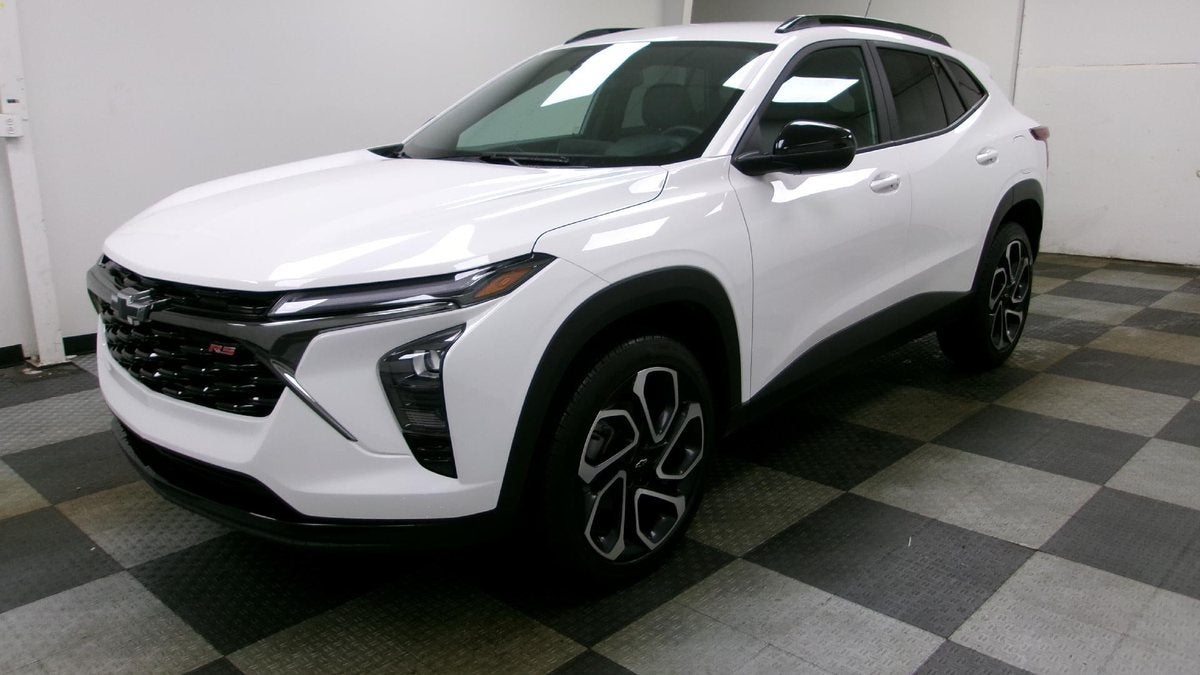
A pre-owned 2025 Chevy Trax 2RS at Lash Chevrolet in Johnstown. Choosing a modestly priced vehicle keeps the amount financed, and the monthly payment, within reach while your credit recovers.
What a Bad Credit Car Loan Really Costs
An APR is an abstract number until you translate it into dollars. The table below holds everything else constant, a $20,000 used-vehicle loan over 60 months with nothing down, and changes only the rate, using Experian's Q2 2026 used-car average for each credit tier.
The gap between the prime and subprime averages works out to about $107 a month and roughly $6,400 in extra interest over five years. That is the real cost of a lower score, and it is also the size of the reward for raising it.
Stretching the term is the most common way to make a subprime payment fit, and it does lower the monthly number. At 19.10%, moving from 60 to 72 months drops the payment to about $469, but total interest climbs to roughly $13,745, and to about $16,400 at 84 months. A less expensive vehicle or a bigger down payment usually beats a longer loan.
Refinancing is the way out of a high rate. After about a year of on-time payments, an improved score may qualify you for a better offer. In this example, refinancing the remaining balance of roughly $17,360 from 19.10% to 13.93% over the remaining 48 months would cut the payment by about $46 a month and save around $2,200 in interest.
| Credit Tier (Average Used-Car APR) | Payment and Total Interest on $20,000 Over 60 Months |
|---|---|
| Super prime (6.29%) | About $389 a month, $3,362 total interest |
| Prime (8.81%) | About $413 a month, $4,800 total interest |
| Near prime (13.93%) | About $465 a month, $7,878 total interest |
| Subprime (19.10%) | About $520 a month, $11,195 total interest |
| Deep subprime (21.62%) | About $548 a month, $12,884 total interest |
Estimates assume a simple-interest loan with no down payment and exclude taxes, title, registration and fees. Your actual terms depend on lender approval.
Choosing a Vehicle That Fits a Credit-Rebuilding Budget
The vehicle you choose shapes the loan as much as your score does. Lenders compare the amount they are lending with the vehicle's value, and a smaller, well-priced loan is easier to approve and easier to repay on time, which is exactly what rebuilds credit.
Used vehicles under $15,000 keep the amount financed low, so the payment stays manageable even at subprime rates. The tradeoff is age and mileage, which makes a vehicle history report and a careful inspection more important here than anywhere else.
Used SUVs and trucks are the sweet spot for many Central Ohio families, offering room and winter traction without a new-vehicle price. Our selection of used Chevy SUVs in Johnstown, OH regularly includes models such as the Equinox, Trailblazer, Traverse and Trax.
Certified pre-owned vehicles cost a little more than comparable used ones, but they pass a detailed inspection and carry added factory-backed warranty coverage, which is valuable protection when a surprise repair bill is the last thing your budget needs.
A new 2026 Chevy Trax starts at $21,700 before destination, making it the most affordable SUV in Chevrolet's 2026 lineup, and it comes with a full factory warranty. Average new-car rates are lower than used-car rates in every credit tier, which can narrow the price gap more than you might expect. Larger new SUVs and trucks are possible with bad credit, but their bigger loan amounts make approval and affordability harder.
| Vehicle Path | Typical Price Point | Loan Size | Advantages | Watch-Outs |
|---|---|---|---|---|
| Used vehicle under $15,000 | Under $15,000 | Smallest | Lowest payment and the easiest approval math | Older, higher-mileage vehicles need a careful inspection |
| Used SUV or truck | Varies with age and mileage | Moderate | Space and capability at a used price | Older trucks can carry higher repair costs |
| Certified pre-owned | Above comparable used vehicles | Moderate | Detailed inspection and added warranty coverage | Costs more than a non-certified equivalent |
| New 2026 Chevy Trax | From $21,700 | Moderate | Full factory warranty and lower average new-car APRs | Faster depreciation in the first few years |
| New larger SUV or truck | Highest | Largest | Newest features, space and capability | Hardest to fit within payment-to-income and debt-to-income limits |
Prices exclude destination, taxes and fees and are subject to change. Inventory varies, so ask us which vehicles fit your approval before you fall for one that does not.
Conclusion
Bad credit car financing in 2026 is less about whether you can be approved and more about what the approval costs. Average used-car rates run from 8.81% for prime borrowers to 19.10% for subprime and 21.62% for deep subprime, and the right preparation, meaning a down payment, documented income, a realistic vehicle and a shorter term, narrows that gap considerably.
Treat this loan as a stepping stone. Make every payment on time, confirm that your lender reports to all three credit bureaus and revisit refinancing after about a year. A lower rate on the next loan is the payoff for the discipline you show on this one.
Lash Chevrolet is a Chevrolet dealership in Johnstown, OH that works with every kind of credit history for drivers across Columbus, Westerville, Gahanna, New Albany, Galena, Sunbury and Pataskala. Bring your questions and your paperwork, and we will walk through every number with you before you sign anything.
Ready to See What You Qualify For?
Visit Lash Chevrolet at 755 W Coshocton St in Johnstown, OH, or call our sales team at 740-809-4293. We will submit your application to our lender network, explain every offer line by line and help you choose a vehicle that fits your budget, whether it is new or pre-owned.
Frequently Asked Questions
Can I get a car loan with bad credit?
Yes. Auto lenders approve loans in every credit tier, including subprime and deep subprime, but a lower score means a higher rate. Experian's Q2 2026 data shows average used-car APRs of 19.10% for subprime borrowers and 21.62% for deep subprime. Steady income, a down payment, proof of residence and a reasonably priced vehicle all improve your approval odds and the terms you are offered.
What credit score is considered bad for a car loan?
Experian's auto finance report, using VantageScore 4.0, labels scores of 501 to 600 as subprime and 300 to 500 as deep subprime, with 601 to 660 counted as near prime. GM Financial describes scores below 620 as subprime. Lenders draw these lines differently, and many use FICO Auto Scores that range from 250 to 900, so the same borrower can land in different tiers with different lenders.
What interest rate will I get on a car loan with bad credit in 2026?
According to Experian's State of the Automotive Finance Market for Q2 2026, subprime borrowers averaged 13.52% APR on new vehicles and 19.10% on used vehicles. Deep subprime borrowers averaged 16.11% new and 21.62% used, while prime borrowers averaged 6.15% new and 8.81% used. Your actual rate depends on the lender, loan term, vehicle, down payment and complete application.
How much down payment do I need with bad credit?
There is no universal minimum, but many subprime lenders ask for some cash down, and 10% or more of the purchase price is a common target. On a $22,000 used vehicle financed for 60 months at 19.10% APR, a 10% down payment lowers the payment by about $57 a month and saves roughly $1,230 in interest. Equity in a trade-in also counts toward your down payment.
Can I get a car loan after bankruptcy or repossession?
Yes, in many cases. Some lenders specialize in financing buyers with a discharged bankruptcy or a past repossession, though rates are higher and a down payment helps. If you are still in an open Chapter 13 repayment plan, you will typically need written permission from your bankruptcy trustee before taking on a new loan. Bringing your discharge or trustee paperwork speeds up the approval.
Will applying with several lenders hurt my credit score?
Usually not much, as long as you shop efficiently. The Consumer Financial Protection Bureau says multiple auto loan credit checks generally count as a single inquiry when they happen within 14 to 45 days of each other, depending on the scoring model. Keep your comparison shopping inside a two-week window, and submitting your application to several lenders will have only a limited effect on your score.
What documents do I need for a bad credit car loan?
Most lenders ask for recent pay stubs or other proof of income, a utility bill or lease showing your current address, a valid driver's license, a list of personal references with phone numbers and proof of insurance. Bring verification of your down payment and the title or payoff letter for any trade-in. Self-employed buyers should bring recent tax returns and bank statements instead of pay stubs.
Can I refinance a bad credit car loan later?
Often, yes. After about 12 months of on-time payments, an improved credit score may qualify you for a lower rate with a bank or credit union. For example, refinancing a remaining $17,360 balance from 19.10% to 13.93% APR over 48 months saves about $46 a month and roughly $2,200 in interest. Check your contract for any prepayment terms before you refinance.
Where can I get bad credit car financing near Columbus, OH?
Lash Chevrolet at 755 W Coshocton St in Johnstown, OH, offers second chance auto financing for drivers across Columbus, Westerville, Gahanna, New Albany, Galena, Sunbury and Pataskala. Our finance team works with local credit unions and a network of national lenders to find terms that fit each application. Sales hours are Monday through Thursday 8 AM to 8 PM, Friday 8 AM to 5 PM and Saturday 9 AM to 6 PM.